Paths, Rivers, and Relations: Native Life in Early Westmoreland County

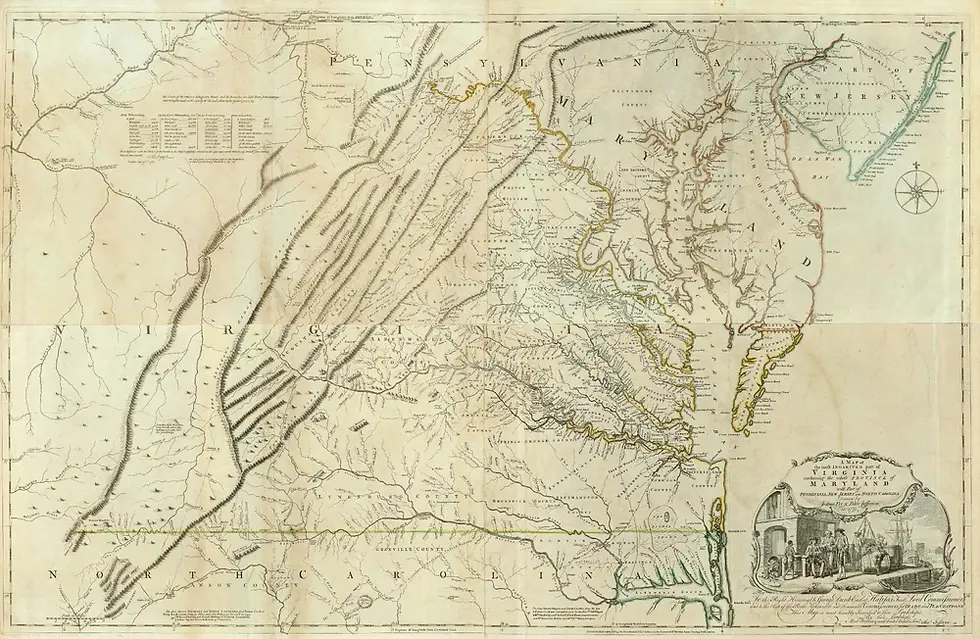
Augustine Herrman, Virginia and Maryland as it is Planted and Inhabited this present year 1670. Library of Congress, Geography and Map Division.
The landscape that became Westmoreland County in 1653 was already a long established Indigenous world shaped by water, movement, and relationship. The Potomac and Rappahannock Rivers formed the core of that world, not as dividing lines, but as connected
corridors through which people, goods, and knowledge moved across the Chesapeake. Archaeological and ethnohistorical research demonstrates that Algonquian speaking communities had occupied and actively shaped these river systems for centuries, developing cultural landscapes rooted in travel, exchange, and environmental stewardship.¹
Communities along these waterways included the Rappahannock, Wicomico, Nanzatico, Morattico, Totuskey, Mattaponi, Doeg, and Patawomeck, among others. These were not isolated groups. They operated within overlapping networks of diplomacy and trade that extended across the Northern Neck and beyond. Rivers functioned as the primary routes linking towns, fishing grounds, and seasonal settlements, while overland paths connected interior and coastal regions. In this system, identity and territory were not fixed to surveyed boundaries but tied to relationships, access, and movement across the landscape.²
Trade was central to this system of life. Long before English settlement, Indigenous exchange networks moved copper, shell beads, furs, and food resources throughout the Chesapeake. These networks did not disappear with colonization. Instead, they adapted, incorporating European materials while continuing to rely on Indigenous knowledge of seasonal movement and geography. Studies of the Potomac River valley demonstrate that trade between Native communities and English settlers, including the exchange of venison and other goods, depended on this deep environmental knowledge and established regional connections.³ Authority within this world was closely tied to the control of movement and exchange. Leaders maintained influence not by owning land in a fixed sense, but by regulating access to routes, resources, and alliances, a system reflected in the broader Powhatan political landscape.¹
The environment itself was actively managed. Fields cleared along riverbanks supported agriculture, while wetlands and forests provided resources that were used seasonally and sustainably. These practices created a landscape that was both productive and dynamic, shaped over generations through intentional use. When English settlers entered the region, they relied heavily on this existing system. Rather than clearing new land, they frequently converted Indigenous agricultural fields into tobacco plantations, embedding colonial economies directly within Native landscapes.²
Colonial settlement introduced new pressures but did not immediately erase Indigenous presence. English land claims were often expansive but unevenly occupied, leaving large areas in continued Native use. At the same time, the proximity of English plantations to Native towns led to increasing interaction, negotiation, and conflict. Indigenous leaders actively engaged colonial authorities, bringing forward complaints regarding land disputes, violence, and unfair treatment. These legal interactions demonstrate that Native communities remained politically active and capable of shaping outcomes within colonial systems.⁴
The Potomac and Rappahannock corridors remained spaces of both connection and tension. Native groups maintained diplomatic and economic relationships with one another and with English settlers, even as displacement and colonial expansion reshaped the region. In response, some communities formed multiethnic towns composed of people from different nations, reflecting both disruption and adaptation.² These developments illustrate the persistence of Indigenous networks, even as the structures surrounding them changed.
Labor systems introduced by the English further complicated this landscape. The expansion of tobacco agriculture depended on indentured servants and enslaved Africans, whose labor sustained plantation economies across the Northern Neck. These individuals were not confined to static spaces. Like Indigenous peoples, they moved through river systems, forests, and informal pathways that had long structured life in the region. Colonial authorities recognized this mobility as a threat and attempted to regulate it through laws and treaties requiring the return of those who escaped.⁵ In practice, however, movement proved difficult to control. Rivers and marginal landscapes provided opportunities for resistance, allowing individuals to navigate beyond the reach of colonial oversight.
These patterns of movement extended into the formation of new communities in difficult environments such as swamps and interior regions, where Indigenous, African, and European experiences intersected.⁵ Such spaces highlight the continued importance of Indigenous geography in shaping the lived realities of all people in the region, even as colonial systems attempted to impose fixed boundaries.
The instability of colonial authority in Westmoreland further reflects the contested nature of this landscape. Conflicts between local officials and Native communities reveal both the limits of colonial governance and the strength of Indigenous diplomacy. In some cases, Native leaders successfully challenged colonial abuses, influencing legal decisions and outcomes. The temporary dissolution of Westmoreland County itself underscores how fragile imposed structures could be in a region defined by overlapping systems of authority.⁴
Westmoreland, then, did not emerge as a fixed colonial space, but as part of a layered and evolving landscape shaped by movement, exchange, and adaptation. The Potomac and Rappahannock Rivers remained central to this story, sustaining networks that predated English settlement and continued to influence the region throughout the seventeenth century. Indigenous communities did not disappear from this landscape. They maintained connections across it, adapted to changing conditions, and actively shaped the world that colonists sought to control.
Understanding Native life in early Westmoreland requires recognizing this continuity. The region’s history is not defined solely by the arrival of English settlers, but by the enduring presence of Indigenous systems of knowledge, movement, and relationship. These systems formed the foundation upon which colonial society was built and continued to shape the Northern Neck long after its transformation into a county.
Footnotes
Jessica Lauren Taylor, Plain Paths and Dividing Lines: Navigating Native Land and Water in the Seventeenth Century Chesapeake (Charlottesville: University of Virginia Press, 2023); Stephen R. Potter, Commoners, Tribute, and Chiefs: The Development of Algonquian Culture in the Potomac River Valley (Charlottesville: University Press of Virginia, 1994).
Taylor, Plain Paths and Dividing Lines, on Native communities and riverine networks in the Potomac and Rappahannock regions.
D. Brad Hatch, “Venison Trade and Interaction between English Colonists and Native Americans in Virginia’s Potomac River Valley,” Northeast Historical Archaeology 41, no. 1 (2012): 18–49.
Taylor, Plain Paths and Dividing Lines, on Native legal action and colonial governance in Westmoreland County.
Taylor, Plain Paths and Dividing Lines, on labor mobility, treaties, and the movement of indentured servants and enslaved people.
Works Cited
Hatch, D. Brad. “Venison Trade and Interaction between English Colonists and Native Americans in Virginia’s Potomac River Valley.” Northeast Historical Archaeology 41, no. 1 (2012): 18–49.
Potter, Stephen R. Commoners, Tribute, and Chiefs: The Development of Algonquian Culture in the Potomac River Valley. Charlottesville: University Press of Virginia, 1994.
Taylor, Jessica Lauren. Plain Paths and Dividing Lines: Navigating Native Land and Water in the Seventeenth Century Chesapeake. Charlottesville: University of Virginia Press, 2023.