
Born Here, Built a Nation: Westmoreland County and the American Revolution
Updated: Aug 20
From the first organized resistance to the Stamp Act to the congressional demand for independence, the battlefield at Trenton and the command of the Continental Army, Westmoreland County’s history is inseparable from the creation of the United States.
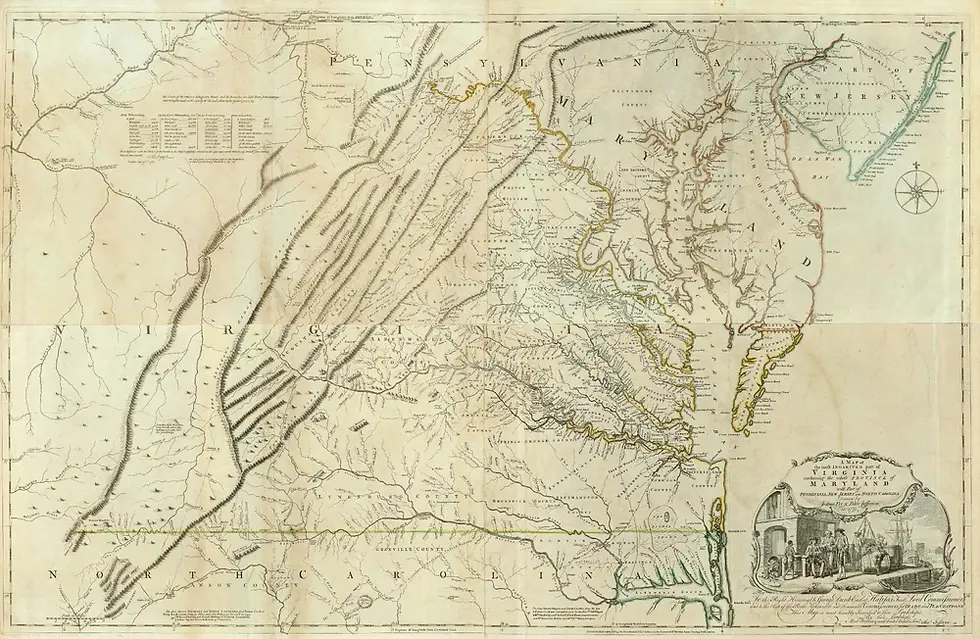
Along the rivers, fields and wooded roads of Virginia’s Northern Neck, Westmoreland County can appear far removed from the chambers of Philadelphia or the frozen battlefields of New Jersey. Yet some of the most consequential political and military actions of the American Revolution were led by people born and shaped here.
George Washington, commander in chief of the Continental Army, was born at Popes Creek. Richard Henry Lee, who formally moved that the colonies declare themselves independent, was born at Stratford Hall. His brother Francis Lightfoot Lee remained in Congress to sign the Declaration and help sustain the revolutionary government. Their younger brother Arthur Lee worked abroad as a political writer, intelligence agent and American diplomat. James Monroe left his studies to join the Continental Army and nearly died at Trenton before eventually becoming the nation’s fifth president.
Westmoreland County produced both the man who commanded the fight for American independence and the man who formally asked Congress to declare it.
That remarkable distinction is only part of the county’s Revolutionary story.
Before independence, resistance at Leedstown
Westmoreland County’s road toward revolution began well before 1776.
In 1765, the British Parliament adopted the Stamp Act, requiring colonists to pay a tax on newspapers, legal documents, licenses and other printed materials. The act generated outrage because it imposed an internal tax through a legislature in which the colonies had no elected representation.
On February 27, 1766, a group of Virginians gathered at Leedstown in Westmoreland County and committed themselves to resisting the act. Their declaration became known as the Westmoreland Resolves, the Leedstown Resolves or the Westmoreland Association.
Richard Henry Lee helped draft the document. Its signers pledged to oppose enforcement of the Stamp Act and to protect one another against anyone attempting to deprive them of their liberty or property under its authority. More than a simple statement of disagreement, the resolves created an organized association for collective resistance.
The Virginia General Assembly has recognized the resolves as an early declaration of colonial dissatisfaction with British taxation. Contemporary scholarship places the Westmoreland Association within the larger resistance movement that developed across British North America during the Stamp Act crisis.[1]
The resolves did not yet demand separation from Great Britain. Their authors continued to claim the rights of British subjects. Nevertheless, the document demonstrated a developing conviction that liberty required organization, mutual obligation and active resistance to unconstitutional authority.
Ten years later, Richard Henry Lee carried that principle into the Continental Congress.
Richard Henry Lee and the legal act of independence
Thomas Jefferson is rightly remembered as the principal author of the Declaration of Independence, but Jefferson did not introduce the congressional motion for independence. That role belonged to Richard Henry Lee of Westmoreland County.
Acting under instructions from the Virginia Convention, Lee rose in Congress on June 7, 1776, and proposed:
“That these United Colonies are, and of right ought to be, free and independent States.”
The Lee Resolution contained three related proposals: a declaration of independence, the formation of foreign alliances and the preparation of a plan of confederation. Together, they addressed the Revolution’s central political necessities. The colonies needed to separate from Britain, seek international assistance and create a government capable of holding the new states together.[2]
Because some delegates considered the proposal premature and others had not yet received permission from their colonial governments to support independence Congress postponed the final vote. In the meantime, it appointed committees to prepare for each part of Lee’s proposal. The Committee of Five, which included Jefferson, John Adams and Benjamin Franklin, was instructed to draft a declaration explaining the case for independence.
On July 2, twelve colonial delegations approved the independence portion of Lee’s resolution. New York abstained because its delegates were still awaiting instructions. Congress then debated and revised Jefferson’s draft before adopting the Declaration of Independence on July 4.[3]
The distinction matters. July 2 was the decisive congressional act of separation; July 4 was the adoption of the document announcing and justifying that decision. The language of Lee’s resolution is echoed in the Declaration itself.
Lee’s public presence was nearly as distinctive as his words. After a hunting accident in 1768, he lost four fingers from his left hand and subsequently covered the injured hand in black silk. The disability did not prevent him from becoming one of the Revolution’s most influential advocates and orators.[4]
He later signed both the Declaration of Independence and the Articles of Confederation. He also became one of Virginia’s first United States senators. His political career stretched from resistance to the Stamp Act through the formation of the constitutional republic.
Francis Lightfoot Lee: sustaining the Revolution
Richard Henry Lee was not Westmoreland County’s only signer of the Declaration.
His younger brother Francis Lightfoot Lee was born at Stratford Hall in 1734. Francis joined Richard in opposing British taxation and signed the Westmoreland Resolves during the Stamp Act crisis. He entered the Continental Congress in 1775 and supported his brother’s movement toward independence.[5]
When family illness called Richard back to Virginia in June 1776, Francis remained in Philadelphia and kept him informed about the congressional debate. He reported the growing support for independence while acknowledging the military dangers facing the colonies.
Francis signed the Declaration and continued serving in Congress during some of the war’s most difficult years. During the winter of 1777–1778, while Washington’s army suffered at Valley Forge, Francis chaired a congressional committee concerned with the army’s condition and support.[6]
His contribution illustrates an important truth about the Revolution: independence required more than battlefield courage and celebrated speeches. It also depended upon committee work, supply systems, correspondence, legislation and representatives willing to continue governing during an unstable war.
Francis never acquired the fame of Washington or the oratorical reputation of Richard Henry Lee. Even within his prominent family, he was known for a comparatively calm and measured temperament. Yet the Revolution relied upon precisely that kind of steady public service.
George Washington: preserving an army and surrendering its power

George Washington was born at Popes Creek in Westmoreland County on February 22, 1732. The landscape was then part of an interconnected Atlantic world shaped by tobacco cultivation, river commerce, inherited wealth and enslaved labor.
The Washington family’s position in colonial Virginia was created through landownership, political connections and the forced labor of enslaved Africans and African Americans. The National Park Service’s research at Popes Creek emphasizes that Washington’s birthplace is not the story of one celebrated child alone. It is also the story of the Washington family, Native peoples, indentured workers and generations of enslaved people whose lives formed the community in which he was born.[7]
In June 1775, the Continental Congress appointed Washington commander in chief of the newly created Continental Army. His most important military achievement was not a single battlefield victory. It was keeping a national army in existence for eight years.
Washington’s forces endured defeats around New York, expiring enlistments, desertion, shortages of food and clothing, political disputes and periods when the Revolution appeared close to collapse. His decision to cross the Delaware and attack Trenton in December 1776 revived American morale after a disastrous campaign. His army survived the winter at Valley Forge, emerged better trained and ultimately joined French forces in compelling the British surrender at Yorktown in 1781.
Washington’s Revolutionary service ended with an act as important to the new republic as many of his military decisions.
On December 23, 1783, he appeared before Congress in Annapolis and resigned his commission as commander in chief. Washington declared that he had finished the work assigned to him and returned the authority entrusted to him by Congress.[8]
Victorious generals throughout history had frequently converted military authority into personal political power. Washington instead placed the army under civilian authority and returned to private life. His resignation helped establish a principle fundamental to the American republic: military power must remain subordinate to civil government.
The Westmoreland-born commander therefore influenced not only how American independence was won, but how power would be transferred after victory.
James Monroe: a teenager at Trenton
James Monroe was born in Westmoreland County on April 28, 1758. He attended Campbelltown Academy, where one of his schoolmates was John Marshall, another Westmoreland native who would later become chief justice of the United States.
Monroe enrolled at the College of William & Mary in 1774, but the approaching war transformed his plans. At approximately 18 years old, he left college and joined the 3rd Virginia Regiment of the Continental Army.
He served during the difficult New York and New Jersey campaign and participated in Washington’s December 1776 attack on Trenton. During the battle, a musket ball struck Monroe in the shoulder and severed an artery. His injury might have been fatal, but a physician intervened and stopped the bleeding. Monroe’s conduct earned him promotion to captain.[9]
He continued serving during the battles of Brandywine, Germantown and Monmouth and spent the winter of 1777–1778 at Valley Forge. Historical accounts describe Monroe sharing quarters there with his former Westmoreland schoolmate John Marshall.
The famous painting Washington Crossing the Delaware is sometimes said to show Monroe holding the American flag. Monroe did participate in the Trenton campaign, but the painting is a later, symbolic depiction rather than a literal record of the crossing. Monroe crossed the Delaware with a different portion of the American force. The popular identification is therefore better understood as historical tradition than documented portraiture.[10]
Even without that legend, Monroe’s experience is extraordinary. Before his nineteenth birthday, a young man from Westmoreland County had left college, crossed an ice-filled river during a winter military operation, led soldiers into combat and survived a nearly fatal wound.
He would later serve as governor, diplomat, secretary of state, secretary of war and president. Yet the Revolution was not simply an introductory chapter in Monroe’s career. He later wrote that its principles had guided him throughout his life.
Arthur Lee and the Revolution beyond the battlefield
The Revolution was also fought in European capitals, newspapers and confidential correspondence.
Arthur Lee, born at Stratford Hall in 1740, trained as both a physician and a lawyer. In London, he became a forceful writer for the American cause and supplied information to patriot leaders. Encyclopedia Virginia describes him as a “doctor, lawyer, spy, diplomat” whose Revolutionary work connected political advocacy, intelligence gathering and foreign relations.[11]
Arthur later served alongside Benjamin Franklin and Silas Deane as an American commissioner in France. The commissioners’ relationships were often contentious, but their mission was essential. The United States needed weapons, credit, diplomatic recognition and foreign military support.
France’s eventual alliance with the United States transformed the war. French soldiers, ships, supplies and financing became indispensable to the campaign that ended at Yorktown.
Arthur Lee’s complicated career reminds us that the American Revolution was simultaneously a civil conflict within the British Empire, an international war and a contest for European support. Westmoreland County’s influence reached not only Congress and the Continental Army, but across the Atlantic.
A remarkable landscape and a complicated inheritance
The concentration of Revolutionary leadership associated with Westmoreland County is remarkable:
George Washington commanded the Continental Army.
Richard Henry Lee introduced the resolution for independence.
Francis Lightfoot Lee signed the Declaration and served in the wartime Congress.
Arthur Lee advanced the American cause through intelligence and diplomacy.
James Monroe fought at Trenton and later became the fifth president.
The Westmoreland Association organized resistance to the Stamp Act a decade before independence.
These histories emerged from a county shaped by the Potomac and Rappahannock rivers, Atlantic commerce, plantation agriculture, family networks and political education. Its waterways connected rural estates to Williamsburg, Maryland, London and the wider Atlantic world. Its relative isolation did not make Westmoreland provincial. The rivers were eighteenth-century highways, carrying people, tobacco, correspondence, merchandise and political ideas.
The splendor of Westmoreland County lies not only in its landscape or its roster of nationally recognized names. It lies in the scale of its connection to the American experiment.
That legacy must also be interpreted honestly. Many celebrated Revolutionary leaders belonged to a wealthy planter class whose influence and economic independence rested upon enslaved labor. The language of natural rights existed alongside racial slavery, restrictions on women’s political participation and the displacement of Indigenous peoples. Independence expanded the possibilities of republican government while leaving many people outside its promised liberty.
Recognizing those contradictions does not diminish Westmoreland County’s importance. It allows us to understand it more fully.
The county’s Revolutionary history is not a simple collection of heroic biographies. It is a history of ideas and actions, courage and contradiction, inherited privilege and public sacrifice. It asks how people came to challenge imperial authority, how political principles were converted into government and warfare, and why the freedoms proclaimed in 1776 remained incomplete.
Westmoreland County and the Founding of the United States
The history of the American Revolution is preserved throughout Westmoreland County. Popes Creek, Stratford Hall, Leedstown, the Monroe family lands and surviving historical records connect the county to the people and political movements that shaped the struggle for independence.
The Westmoreland Association’s opposition to the Stamp Act anticipated arguments that Richard Henry Lee later presented before the Continental Congress. George Washington commanded the army that defended the independence Lee proposed. James Monroe entered the Continental Army as a young man and was nearly killed at Trenton. Francis Lightfoot Lee served in the wartime Congress, while Arthur Lee promoted American interests through diplomacy and intelligence work in Europe.
These histories establish Westmoreland County as more than the birthplace of several prominent founders. The county contributed directly to the development of colonial resistance and influenced the military, political, and diplomatic course of the Revolution. Studying these individuals alongside the communities in which they lived provides a fuller understanding of the creation of the United States and the contradictions that remained within its founding principles.
Sources and further reading
Virginia General Assembly, House Joint Resolution No. 906: Commemorating the Signing of the Leedstown Resolves; Encyclopedia Virginia, “The Stamp Act in Virginia”.
National Archives, “Lee Resolution (1776)”.
National Archives, “Declaration of Independence: A History” and “Creating the Declaration: A Timeline”.
National Constitution Center, “Richard Henry Lee”; Encyclopedia Virginia, “Richard Henry Lee (1732–1794)”.
U.S. House of Representatives: History, Art & Archives, “Francis Lightfoot Lee”.
National Constitution Center, “Francis Lightfoot Lee”; Encyclopedia Virginia, “Francis Lightfoot Lee (1734–1797)”.
National Park Service, George Washington Birthplace National Monument, park history and stories, and official park brochure.
George Washington’s Mount Vernon, “Resignation of Military Commission” and “Washington and Civilian Authority”.
James Monroe Museum and Memorial Library, “Revolutionary Idealist”; American Battlefield Trust, “James Monroe”.
Museum of the American Revolution, “James Monroe”.
Encyclopedia Virginia, “Arthur Lee (1740–1792)”.

